

Wheel Stops vs. Bollards: Key Differences & Uses
When designing a safe and efficient parking area, choosing the right protective equipment is critical. Wheel stops and bollards are two commonly used traffic safety products, but they serve different purposes. Understanding the differences between wheel stops and bollards can help property owners, contractors, and facility managers make the right decision for parking lots, warehouses, commercial buildings, and public spaces.
In this article, we’ll compare wheel stops vs. bollards in terms of function, installation, cost, and ideal applications.
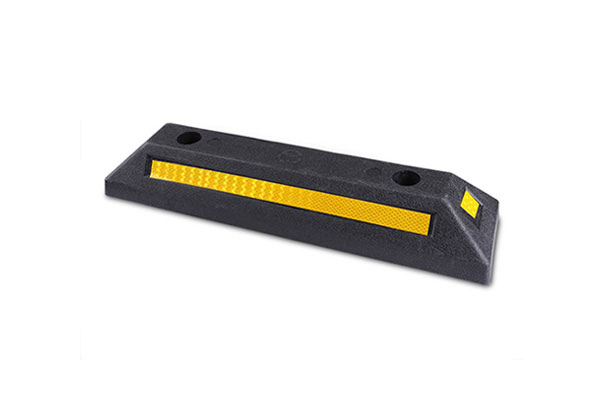
What Are Wheel Stops?
Wheel stops, also known as parking blocks or car stops, are low-profile barriers installed at the front of parking spaces. Their primary function is to prevent vehicles from rolling too far forward and hitting walls, sidewalks, fences, or other parked vehicles.
Key Features of Wheel Stops
- Installed horizontally on the ground
- Made from rubber, concrete, plastic, or recycled materials
- Clearly marked with reflective strips for visibility
- Designed to control parking position, not stop high-speed impact
Common Applications
- Parking lots and garages
- Residential parking areas
- Commercial and retail parking spaces
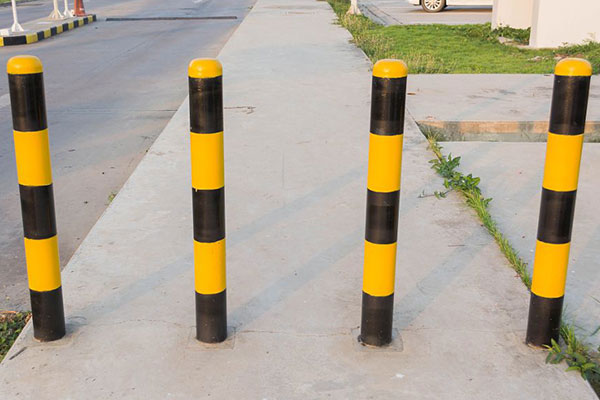
What Are Bollards?
Bollards are vertical posts installed into or onto the ground to control vehicle access and protect structures or pedestrians. They are designed to withstand stronger impacts compared to wheel stops.
Key Features of Bollards
- Installed vertically, either fixed or removable
- Made from steel, stainless steel, concrete, or plastic
- Can be decorative or high-security (crash-rated)
- Highly visible and often reflective
Common Applications
- Building entrances and storefronts
- Pedestrian zones
- Warehouses and industrial facilities
- Security-sensitive areas
Wheel Stops vs. Bollards: Key Differences
1. Function and Purpose
- Wheel Stops: Position vehicles correctly within parking spaces and prevent over-rolling.
- Bollards: Block, redirect, or stop vehicles to protect people and infrastructure.
2. Impact Resistance
- Wheel Stops: Suitable for low-speed, controlled parking scenarios.
- Bollards: Designed to handle higher impact forces and vehicle collisions.
3. Installation
- Wheel Stops: Surface-mounted with anchor bolts; quick and easy to install.
- Bollards: Often require core drilling or concrete foundations; more complex installation.
4. Cost
- Wheel Stops: More affordable and cost-effective for large parking areas.
- Bollards: Higher cost due to materials, foundation work, and security performance.
5. Space Usage
- Wheel Stops: Low-profile and do not obstruct pedestrian views.
- Bollards: Take up vertical space and can influence traffic flow and aesthetics.
Which One Should You Choose?
Choose wheel stops if:
- You need to organize parking spaces
- Vehicles move at low speeds
- Budget efficiency is a priority
- The goal is positioning rather than impact protection
Choose bollards if:
- You need to protect buildings, equipment, or pedestrians
- Vehicle impact resistance is required
- Access control is necessary
- Long-term durability and security are important
In many projects, wheel stops and bollards are used together to create a comprehensive parking and traffic safety system.
Wheel Stops vs. Bollards: Comparison Table
| Feature | Wheel Stops | Bollards |
|---|---|---|
| Primary Function | Parking position control | Vehicle impact protection |
| Installation | Surface-mounted | Embedded or surface-mounted |
| Impact Resistance | Low | Medium to High |
| Cost | Low | Medium to High |
| Best Use | Parking spaces | Entrances & protection zones |
Conclusion
When comparing wheel stops vs. bollards, the best choice depends on your specific safety needs. Wheel stops are ideal for controlling parking behavior, while bollards are essential for protecting people and property from vehicle impact. By understanding their differences, you can design safer, more efficient parking and traffic management systems.