

All-in-One vs. Split Solar Street Lights: How to Choose
Solar street lights are widely used for roads, residential areas, parking lots, parks, industrial sites, and other outdoor lighting projects. Because they operate independently from the electrical grid, they can reduce cabling work and simplify installation in locations where grid power is unavailable or expensive to extend.
Two of the most common designs are all-in-one solar street lights and split solar street lights. Both use solar energy to provide outdoor lighting, but their structure, installation, maintenance, solar charging capability, and suitable applications are different.
This guide compares all-in-one vs. split solar street lights to help you understand these differences and choose the right system for your project.
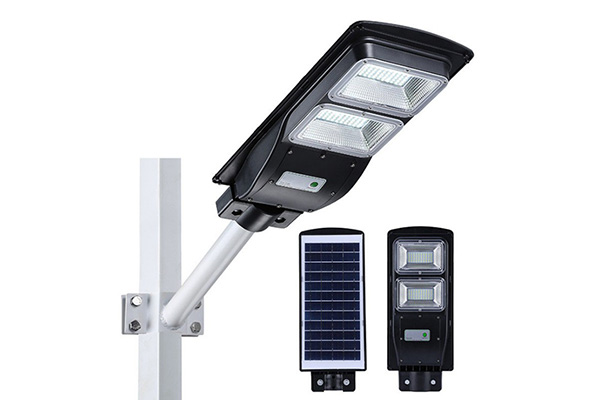
What is an All-in-One Solar Street Light?
An all-in-one solar street light is an integrated lighting system that combines the LED light, solar panel, battery, controller, and other major components into one compact unit.
The complete lighting unit is normally mounted directly on the top or arm of the light pole. Since most components are integrated before delivery, there is less wiring and assembly required on site.
All-in-one solar street lights are commonly used for:
- Residential streets
- Community roads
- Parks and pathways
- Parking areas
- Schools and campuses
- Rural roads
- Small and medium outdoor lighting projects
Their main advantages are compact design, simple installation, and relatively easy project deployment.
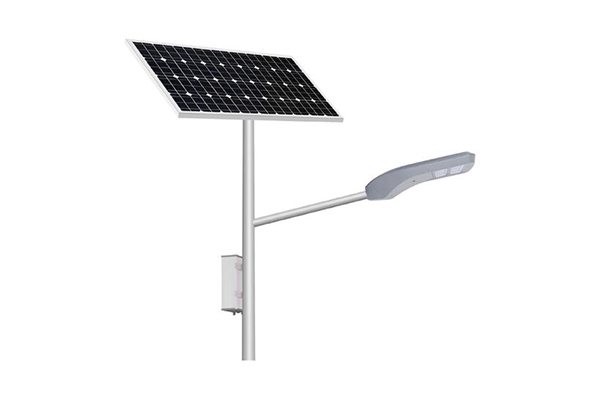
What is a Split Solar Street Light?
A split solar street light uses separate components rather than integrating everything into one housing.
The LED lamp is installed on the pole arm, while the solar panel is mounted separately. Depending on the system design, the battery may be installed on the pole, underneath the solar panel, or in another protected location.
Because the components are separated, the solar panel can usually be larger and its installation angle can be adjusted according to local solar conditions.
Split solar street lights are commonly used for:
- Main roads
- Highways
- Large parking areas
- Industrial facilities
- Remote locations
- Areas with limited sunlight
- High-power lighting projects
They offer greater flexibility when solar panel capacity, battery capacity, or lighting power needs to be customized.
All-in-One vs. Split Solar Street Lights: Quick Comparison
| Feature | All-in-One Solar Street Light | Split Solar Street Light |
|---|---|---|
| Structure | Components integrated into one unit | Main components installed separately |
| Installation | Faster and simpler | More installation work required |
| Wiring | Minimal external wiring | More wiring between components |
| Solar Panel Size | Usually limited by integrated design | Can support larger panels |
| Panel Angle | Less flexible | More flexible |
| Battery Capacity | Generally limited by housing size | Easier to use larger batteries |
| Maintenance | Integrated modules simplify access but may require unit-specific parts | Individual components can be serviced or replaced |
| Appearance | Compact and modern | More traditional solar lighting structure |
| Customization | Moderate | High |
| Typical Application | General roads, communities, parks | Large roads, demanding or customized projects |
All-in-One vs. Split Solar Street Lights: Key Differences
1. Design and Structure
The most obvious difference is how the components are arranged.
An all-in-one solar street light combines most major components into a compact lighting unit. This reduces the number of separate parts installed on the pole and gives the system a cleaner appearance.
A split solar street light separates the solar panel, LED fixture, battery, and controller. Although the structure is more complex, it provides more flexibility when designing the system for specific project requirements.
2. Installation
All-in-one models generally have an advantage when installation speed is important.
Because the main components are already integrated, installers mainly need to prepare the pole, mount the lighting unit, adjust its orientation, and complete the necessary setup.
Split systems require additional work because the solar panel, lamp, battery, and wiring may need to be installed separately.
For projects involving a large number of lighting points, simpler installation can help reduce on-site labor and installation time.
3. Solar Panel Capacity
Solar panel capacity is an important consideration, especially in areas with lower solar irradiation or long periods of cloudy weather.
The solar panel on an all-in-one light must fit within the integrated structure. This can limit the available panel area.
With a split system, the solar panel is independent from the LED fixture. A larger panel can therefore be selected when more charging capacity is required.
The panel can also be positioned and tilted according to local sunlight conditions, providing greater design flexibility.
4. Battery Capacity
Battery capacity determines how much solar energy can be stored for nighttime operation and cloudy days.
All-in-one street lights normally use compact lithium battery systems that fit inside the integrated housing. Modern designs can provide good performance, but physical space still limits how large the battery can be.
Split solar street lights provide more freedom in battery selection because the battery does not necessarily need to fit inside the lamp housing.
For projects requiring long lighting hours or greater autonomy during consecutive cloudy days, a split configuration may provide more options.
5. Lighting Power
Both types are available in different power configurations, so an all-in-one design does not automatically mean lower lighting performance.
However, high-output projects usually require careful matching between:
LED power + solar panel capacity + battery capacity + local solar conditions.
Split systems make it easier to increase solar panel and battery capacity independently, which can be useful for demanding road lighting projects.
For ordinary streets, pathways, communities, and parking areas, properly designed all-in-one systems can provide sufficient lighting performance.
6. Maintenance
Maintenance requirements also differ between the two designs.
With an all-in-one system, major components are concentrated in one unit, making the installation compact and reducing external wiring. However, replacing an internal component may require opening the integrated housing or using compatible replacement modules.
A split system provides easier access to individual components. For example, the solar panel, battery, controller, or LED lamp can usually be inspected and replaced separately.
For long-term projects, buyers should consider not only initial installation but also the availability of replacement batteries, controllers, LED modules, and other spare parts.
7. Cost
There is no universal answer to which type is cheaper.
The final solar street light price depends on factors such as:
- LED power
- Solar panel wattage
- Battery type and capacity
- Pole height
- Lighting hours
- Required backup days
- Controller functions
- Material and protection level
- Project quantity
- Transportation and installation costs
All-in-one systems can reduce installation and wiring costs because of their integrated structure.
Split systems may require more components and installation work, but they provide greater flexibility for high-capacity and customized configurations.
Therefore, buyers should compare the total project cost rather than only the unit price of the lamp.
Advantages of All-in-One Solar Street Lights
All-in-one solar street lights are particularly suitable when simplicity and installation efficiency are priorities.
Their main advantages include:
- Compact integrated design
- Faster installation
- Less external wiring
- Clean and modern appearance
- Easier transportation and deployment
- Suitable for standardized projects
- Reduced on-site assembly work
They are a practical choice for many municipal, residential, commercial, and rural lighting applications.
Advantages of Split Solar Street Lights
Split solar street lights provide greater system flexibility.
Their main advantages include:
- Larger solar panels can be used
- Solar panel angle can be adjusted independently
- Greater battery capacity options
- Individual components can be replaced separately
- Easier customization for different locations
- Suitable for high-power lighting requirements
- Better flexibility for challenging solar conditions
For engineering projects with specific lighting or autonomy requirements, these advantages can be important.
All-in-One or Split Solar Street Light: Which Should You Choose?
The right choice depends on the actual project conditions rather than simply choosing one design over the other.
Choose an all-in-one solar street light when you need a compact system, fast installation, minimal wiring, and straightforward maintenance for standard outdoor lighting applications.
Choose a split solar street light when the project requires larger solar panels, higher battery capacity, flexible panel orientation, or a highly customized system configuration.
Before making a decision, consider:
- Road width
- Required illumination level
- Pole height
- Daily lighting hours
- Local peak sun hours
- Rainy or cloudy days
- Required backup time
- Installation environment
- Maintenance requirements
- Project budget
Conclusion
Now you know how all-in-one and split solar street lights differ. All-in-one lights offer a compact design and simpler installation. Split lights offer more flexibility in panel placement and system configuration.
For the best result, compare complete proposals based on your site’s lighting needs, sunlight conditions, and required operating hours—not just the advertised LED wattage.