

LED Street Lights: Benefits, Types and Buying Guide
LED street lights are energy-efficient outdoor lighting fixtures designed for roads, highways, parking areas, residential streets and public spaces. Compared with traditional high-pressure sodium or metal halide lamps, LED street lighting provides better visibility, lower energy consumption and a longer service life.
This guide explains how LED street lights work, their main components and benefits, and how to select the right model for your project.
What is an LED Street Light?
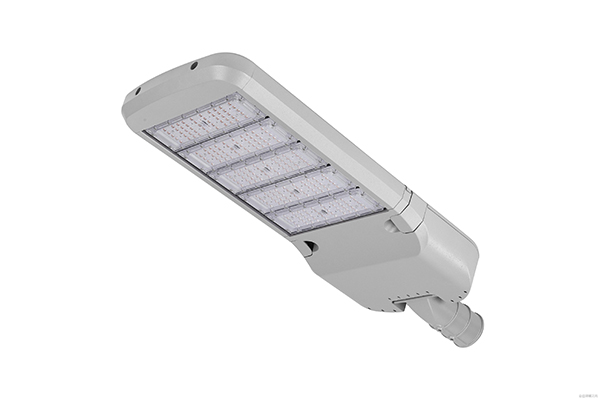
An LED street light is a lighting fixture that uses light-emitting diodes (LEDs) to illuminate roads, highways, parking lots, residential streets and other public areas. It can be powered by the electrical grid or connected to a solar lighting system.
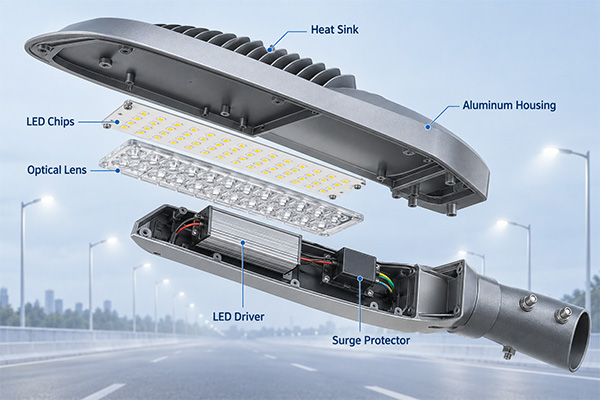
A typical LED street light consists of LED chips, optical lenses, an LED driver, a heat-dissipating aluminum housing and surge protection. The LED chips produce light, while the lenses direct it evenly onto the road. Compared with traditional sodium or metal halide street lamps, LED street lights offer higher energy efficiency, more controllable light distribution, instant illumination and a longer service life.
They are widely used for:
- Urban and rural roads
- Highways and expressways
- Residential streets
- Industrial parks
- Parking lots
- Bridges and tunnels
- Airports and ports
- Public squares and pathways
How Do LED Street Lights Work?
Electricity first passes through the LED driver, which converts the incoming power into the voltage and current required by the LED chips. The chips then produce light, while optical lenses distribute it across the road.
Heat generated during operation is transferred to the aluminum housing and released into the surrounding air. Effective heat dissipation is important because excessive heat can reduce LED brightness and shorten the service life of the fixture.
Main Components of an LED Street Light
1. LED Chips
LED chips determine the fixture’s brightness, efficiency, color consistency and long-term performance. High-quality chips generally offer better lumen maintenance and more stable lighting.
2. LED Driver
The driver regulates the electrical current supplied to the LEDs. A reliable driver can protect the fixture against voltage fluctuations, overheating, overcurrent and short circuits.
3. Optical Lens
The lens controls how light is distributed on the road. Different road widths, pole heights and installation arrangements require different beam patterns.
4. Heat Sink
The heat sink transfers heat away from the LED chips. Most LED street light housings are made from die-cast aluminum because it provides good thermal conductivity and corrosion resistance.
5. Protective Housing
The housing protects the internal components from rain, dust, impact and outdoor environmental conditions. It should have an appropriate IP and IK rating for the project.
6. Surge Protection Device
A surge protection device helps protect the light from sudden voltage spikes caused by lightning or unstable electrical systems.
Benefits of LED Street Lights
Lower Energy Consumption
LED street lights can produce high lumen output while using less electricity than many traditional street lamps. This can significantly reduce municipal and commercial lighting costs.
Long Service Life
A properly designed LED street light can operate for many years with limited maintenance. Actual service life depends on chip quality, driver reliability, temperature management and operating conditions.
Better Road Visibility
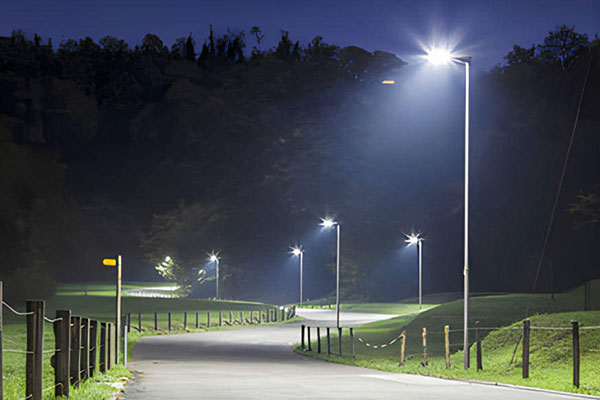
LED lighting offers good color rendering and can make road markings, pedestrians, vehicles and obstacles easier to identify at night.
Instant Start
LED street lights reach full brightness immediately after being switched on. They do not require the warm-up period associated with some traditional lamps.
Directional Lighting
LED optics direct light toward the road instead of dispersing it in every direction. This improves light utilization and can help reduce glare and light pollution when the fixture is properly selected and installed.
Reduced Maintenance
The long operating life of LED fixtures reduces the frequency of lamp replacement. This is especially valuable for highways, bridges and other locations where maintenance is difficult or expensive.
Smart Lighting Compatibility
LED street lights can be equipped with photocells, motion sensors, timers, dimming controls and remote monitoring systems. These features allow lighting output to be adjusted according to traffic, time or environmental conditions.
Common Types of LED Street Lights
| Type | Main Features | Typical Applications |
|---|---|---|
| Standard LED street light | Connected to the electrical grid | Urban roads and residential streets |
| Solar LED street light | Uses solar panels, batteries and controllers | Rural roads and areas without grid power |
| Smart LED street light | Supports dimming and remote monitoring | Smart cities and municipal projects |
| All-in-one solar street light | Main solar components integrated into one unit | Pathways and local roads |
| Split solar street light | Solar panel, battery and lamp installed separately | Roads requiring flexible system design |
| High-power LED street light | High lumen output and wide lighting coverage | Highways, ports and industrial areas |
LED Street Lights vs Traditional Street Lights
| Feature | LED Street Light | Traditional Street Light |
|---|---|---|
| Energy efficiency | High | Generally lower |
| Start-up time | Instant | Some lamps require warm-up |
| Light direction | Easy to control | More scattered |
| Service life | Long | Usually shorter |
| Maintenance | Less frequent | More frequent |
| Dimming | Easy to integrate | Often limited |
| Color rendering | Generally better | Depends on lamp type |
| Smart controls | Widely compatible | More difficult to integrate |
Important LED Street Light Specifications
1. Wattage
Wattage indicates power consumption, but it does not directly represent brightness. Two street lights with the same wattage may produce different lumen outputs because of differences in LED efficiency and fixture design.
2. Lumen Output
Lumens measure the total amount of visible light produced by the fixture. When comparing LED street lights, consider both total lumens and lumens per watt.
3. Luminous Efficiency
Luminous efficiency is measured in lumens per watt. A higher value means the light produces more illumination from the same amount of electrical power.
4. Color Temperature
Common LED street light color temperatures include:
- 3000K: warm white light
- 4000K: neutral white light
- 5000K–6500K: cool white light
The correct color temperature depends on road type, local regulations, visibility requirements and surrounding conditions. Extremely cool light is not always the best option, especially in residential areas.
5. Color Rendering Index
The Color Rendering Index, or CRI, indicates how accurately colors appear under the light. Better color rendering can help drivers and pedestrians distinguish objects and road conditions more easily.
6. IP Rating
The IP rating describes protection against dust and water. Outdoor street lights commonly require a high protection level, such as IP65 or IP66, depending on the installation environment.
7. IK Rating
The IK rating measures resistance to mechanical impact. A higher rating may be required in public areas where fixtures face a greater risk of damage.
8. Beam Angle and Light Distribution
The beam pattern should match the road width, pole spacing and mounting height. Proper light distribution improves uniformity and reduces dark areas between poles.
9. Power Factor
A high power factor allows the fixture to use electrical power more effectively and can reduce the load on the power supply system.
10. Surge Protection
Street lights are exposed to electrical surges and lightning. The required surge protection level should be selected according to the local electrical environment and project requirements.
How to Choose LED Street Lights
1. Identify the Application
Begin by determining whether the lights will be installed on a highway, urban road, residential street, parking lot or pathway. Each application has different brightness, uniformity and installation requirements.
2. Confirm the Road Dimensions
Provide the road width, number of lanes, pole height, pole spacing and installation arrangement. These details are necessary for selecting the right wattage and optical lens.
3. Focus on Lighting Performance
Do not choose a street light based only on wattage. Compare lumen output, luminous efficiency, light distribution, uniformity and glare control.
4. Check the Main Components
Evaluate the brands and specifications of the LED chips, driver, surge protector, housing and optical lens. Reliable components usually provide more stable long-term performance.
5. Consider the Climate
High temperatures, heavy rain, dust, snow, salt spray and strong winds can affect outdoor lighting equipment. The housing material and protection rating should match the local environment.
6. Review Control Options
Consider whether the project requires photocell control, scheduled dimming, motion sensing or remote monitoring. Smart controls can further reduce energy use.
7. Request a Lighting Simulation
For larger projects, a professional lighting simulation can calculate illumination levels, uniformity and pole spacing before installation. This helps prevent fixtures from being overpowered, underpowered or incorrectly positioned.
LED Street Light Installation Considerations
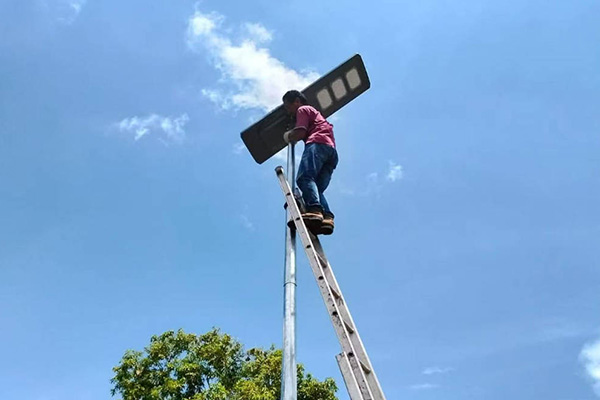
Correct installation is essential for achieving the planned lighting performance. Important factors include:
- Pole height and spacing
- Mounting arm angle
- Fixture tilt
- Road width
- Lighting arrangement
- Cable and electrical protection
- Grounding and surge protection
- Nearby buildings and trees
An excessive upward tilt can increase glare and direct light outside the road. The fixture angle should therefore be adjusted according to the optical design and project layout.
Electrical installation should be completed by qualified personnel and follow applicable local standards.
Maintenance of LED Street Lights
LED street lights require less maintenance than many conventional lamps, but regular inspection is still necessary.
- Cleaning dust and dirt from the lens
- Checking cables and electrical connections
- Inspecting the driver and surge protector
- Confirming that the fixture is securely mounted
- Removing branches or objects blocking the light
- Monitoring brightness reduction or color changes
- Replacing damaged seals to maintain water resistance
A modular street light design can make it easier to replace the driver, LED module or surge protection device without replacing the entire fixture.
FAQs
Grid-powered lights use the local electrical network. Solar LED street lights use solar panels and batteries, making them suitable for locations where grid connection is unavailable or expensive. Solar systems require careful calculation of battery capacity, solar panel output and local sunlight conditions.
Neutral white light around 4000K is commonly used because it provides a balance between visibility and visual comfort. Warmer light may be preferred in residential areas, while cooler light may be used for certain industrial or high-visibility applications.
LED street lights typically last 50,000 to 100,000 operating hours. If used for about 12 hours per night, this equals approximately 11 to 23 years of service. The actual lifespan depends on the quality of the LED chips and driver, heat dissipation, operating temperature, voltage stability and maintenance conditions.
Conclusion
Now you understand how LED street lights work, their main benefits and the specifications that affect their performance.
The right LED street light should provide sufficient brightness, uniform road coverage, effective heat dissipation and reliable protection against outdoor conditions. Before purchasing, consider the road dimensions, pole arrangement, component quality, optical distribution and control requirements rather than selecting a fixture by wattage alone.
If you are planning a road lighting project, RoadSky can provide reliable LED street lights for urban roads, highways, residential streets, parking lots and other outdoor areas. Send us your road width, pole height, pole spacing and lighting requirements, and our team will recommend a suitable model and provide a competitive quotation.