

What Are Crowd Control Barriers? Types, Uses, and Benefits
Crowd control barriers are temporary or permanent physical barriers designed to manage pedestrian movement, organize queues, restrict access to specific areas, and improve public safety. They are commonly used at concerts, sporting events, construction sites, public gatherings, transportation hubs, and other locations where large numbers of people need to be managed safely.
Available in materials such as galvanized steel, aluminum, and plastic, crowd control barriers come in different designs to meet various crowd management requirements. Choosing the right barrier helps event organizers, contractors, security teams, and facility managers maintain order while creating safer and more organized public spaces.
In this guide, we explain what crowd control barriers are, the different types available, their common applications, and how to choose the right solution for your project.
What is a Crowd Control Barrier?
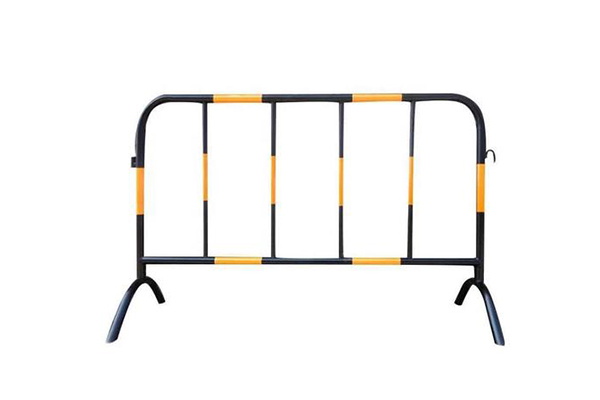
A crowd control barrier is a physical structure used to guide, separate, or restrict pedestrian movement in a designated area. It creates clear boundaries between pedestrians, vehicles, restricted zones, and operational areas without necessarily requiring permanent construction.
Crowd control barriers are also known as pedestrian barriers, crowd management barriers, or event barriers. Depending on their design and intended application, they may be freestanding, interlocking, retractable, or water-filled.
Unlike permanent fencing, most temporary crowd control barriers can be installed, repositioned, and removed quickly. This makes them suitable for locations where crowd flow and access requirements change frequently.
The primary purposes of crowd control barriers include:
- Managing pedestrian flow: Direct people along designated routes and prevent unnecessary congestion.
- Organizing queues: Maintain orderly lines at entrances, ticket counters, and service areas.
- Restricting access: Prevent unauthorized entry into restricted or hazardous areas.
- Improving public safety: Establish separation between pedestrians, vehicles, equipment, and work zones.
- Supporting event operations: Help security personnel manage entrances, exits, waiting areas, and crowd movement.
What Are Crowd Control Barriers Used For?
Crowd control barriers serve a wide range of purposes across public events, construction projects, transportation facilities, and commercial environments.
1. Events and Festivals
Concerts, music festivals, exhibitions, and outdoor celebrations often attract large crowds. Crowd control barriers help define audience areas, organize entry and exit routes, and establish restricted zones around stages or technical equipment.
Heavy-duty event barriers may be required where organizers need more robust physical separation. However, barriers alone cannot guarantee crowd safety; suitable crowd capacity planning, emergency exits, and trained personnel are also essential.
2. Construction Sites and Roadworks
Construction sites and road maintenance projects frequently require temporary pedestrian management. Barriers help separate workers and pedestrians from equipment, excavation areas, and other potential hazards.
For roadworks, crowd control barriers may be used alongside traffic cones, road barricades, warning signs, and pedestrian diversion systems. They should be selected according to the specific hazards and local safety requirements.
3. Sporting Events
Stadiums, marathons, cycling races, and other sporting events use barriers to establish spectator zones, guide participants, and manage queues at access points.
Interlocking metal barriers are particularly useful for temporary outdoor events because they can be connected into continuous lines and rearranged as event layouts change.
4. Public Spaces and Transportation Hubs
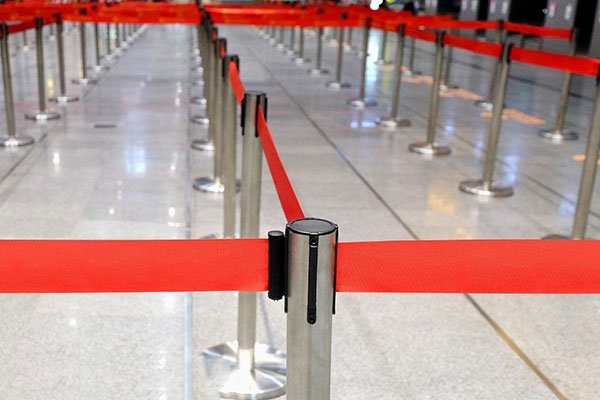
Airports, railway stations, bus terminals, shopping centers, and government facilities use crowd control barriers to organize waiting lines and regulate access.
Retractable belt barriers are suitable for indoor queues, while durable metal barriers may be more appropriate for outdoor environments or locations that require frequent deployment.
5. Emergency and Security Operations
During emergency responses, police operations, or public safety incidents, barriers can help establish exclusion zones and guide people away from dangerous areas.
The barrier type should match the level of risk. Standard pedestrian barriers are not necessarily designed to withstand vehicle impacts or intense crowd pressure.
What Are the Different Types of Crowd Control Barriers?
Crowd control barriers are available in several designs. Each type offers different advantages in terms of portability, durability, stability, and crowd management performance.
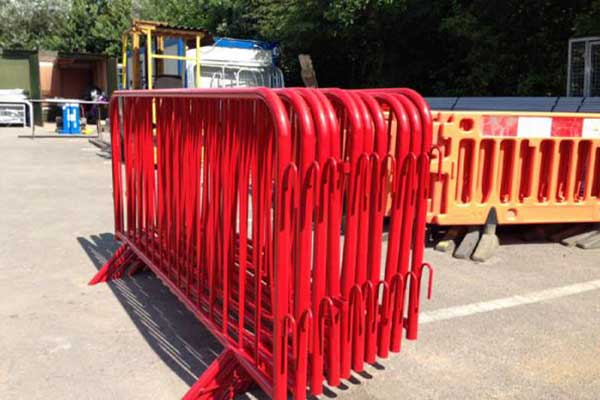
1. Steel Crowd Control Barriers
Steel crowd control barriers are among the most widely used options for outdoor events, public gatherings, and temporary pedestrian management.
They are typically manufactured from steel tubing and may feature galvanized or powder-coated finishes to improve corrosion resistance and service life.
Key advantages:
- Durable construction for repeated use
- Interlocking designs for continuous barrier lines
- Suitable for outdoor events and public spaces
- Easy to transport and store when designed for stacking
Steel barriers are a practical choice for event organizers, rental companies, construction contractors, and security service providers.
2. Aluminum Crowd Control Barriers
Aluminum barriers offer a lightweight alternative to steel models. Their lower weight makes transportation, handling, and installation easier, particularly for applications that require frequent repositioning.
Aluminum is naturally corrosion-resistant, although the overall performance of a barrier also depends on its design, surface treatment, connectors, and operating environment.
These barriers are often suitable for exhibitions, indoor venues, temporary events, and applications where portability is a priority.
3. Plastic Crowd Control Barriers
Plastic crowd control barriers are commonly manufactured from durable polymers such as polyethylene. Some models are designed to be filled with water or sand to increase stability.
Water-filled barriers are particularly useful for temporary outdoor applications, including roadworks, pedestrian diversions, and event perimeters.
Key advantages:
- Lightweight when empty
- Easy to transport and deploy
- Highly visible when manufactured in bright colors
- Suitable for temporary pedestrian separation
4. Retractable Belt Barriers
Retractable belt barriers consist of posts with integrated retractable belts. They are commonly used to organize queues in airports, hotels, banks, retail stores, museums, and exhibition halls.
Their main advantage is flexibility. Staff can extend, retract, and reconnect the belts as queue layouts change.
Retractable belt barriers are best suited to orderly pedestrian guidance and light access control rather than applications requiring strong physical resistance.
5. Interlocking Pedestrian Barriers
Interlocking pedestrian barriers feature connecting hooks or other coupling systems that allow individual units to form a continuous line.
They are especially useful for temporary outdoor installations because the barrier layout can be extended, shortened, or reconfigured as required.
Common applications include public events, sporting competitions, construction areas, and pedestrian diversion routes.
6. Heavy-Duty Crowd Control Barriers
Heavy-duty crowd control barriers are designed for applications that require more robust construction or greater stability than standard lightweight barriers.
Depending on their design, they may feature reinforced frames, stronger connectors, wider support feet, or specialized crowd-facing panels.
What Are the Benefits of Crowd Control Barriers?
Investing in suitable crowd control barriers provides several operational and safety benefits.
Improved Pedestrian Safety
Barriers help separate pedestrians from restricted areas, equipment, and designated vehicle routes. Clearly defined boundaries can reduce confusion and support safer movement.
Better Crowd Flow Management
Organized pedestrian routes make it easier for visitors to find entrances, exits, service points, and waiting areas. Properly positioned barriers can also help reduce unnecessary crossing between pedestrian streams.
Flexible Installation
Many crowd control barriers are designed for temporary use. Their modular construction allows organizers to adapt layouts to different event sizes, site conditions, and operational requirements.
Reusability and Cost Efficiency
Durable, reusable barriers can reduce the need to purchase disposable or temporary separation materials for every project. Stackable designs can also reduce storage and transportation requirements.
Professional Site Organization
Well-positioned barriers help create clearly defined zones, improve wayfinding, and present a more organized environment for visitors, workers, and security personnel.
How to Choose the Right Crowd Control Barriers
Choosing the right crowd control barriers depends on your application, environment, and budget. Consider the following factors before purchasing.
1. Application
Choose barriers based on where they will be used, such as construction sites, public events, pedestrian routes, or queue management areas.
2. Material
Steel barriers offer durability for outdoor use, while aluminum and plastic barriers are lightweight and easy to handle.
3. Size and Stability
Check the barrier height, length, base design, and connection system to ensure suitable stability and coverage.
4. Quality and Safety
Review product specifications, corrosion resistance, and relevant test reports. Ensure the barriers meet local safety requirements.
5. Cost and Supplier
Compare prices, durability, shipping costs, and customization options. Choose a reliable crowd control barrier supplier that can meet your quality and delivery requirements.
Conclusion
Crowd control barriers are essential tools for organizing pedestrian movement, managing queues, defining restricted areas, and supporting safer public spaces. From lightweight retractable belt systems to durable steel pedestrian barriers and water-filled plastic barriers, different designs serve different operational needs.
Roadsky supplies quality crowd control barriers for various project needs. Contact Roadsky today to discuss your requirements and get a competitive quotation for your next project.